Friday, May 23, 2014

Where is Brigadoon?


To the surprise of many, the mystical…or I should say mythical…village of Brigadoon is not actually located in the Scottish Highlands...nor anywhere else.  My guess is that the sound of “Brigadoon” fit the artistic touch for Lerner & Lowe’s 1947 musical better than the “Brig o’ Spean”, or the Brig o’ Dornie”.  “Brigadoon” just sounds a wee bit more mystical for the stage play musical production.  Actually Brig o’ Doon means…Bridge over the River Doon. 

Recently we visited the Brig o’ Doon.  The River Doon winds its way through south Ayrshire in the lowlands of Scotland and empties into the Firth of Clyde just south of Ayr near a small village named Alloway

 
This is the Brig o' Doon.
 
 
The River Doon looking up river from the bridge

 
Looking down river


Alloway is the birth place of Robert Burns (1759 – 1796), who is widely regarded as the national poet of Scotland and is celebrated worldwide.

 
Burns' Cottage
 
The garden at Burns' Cottage

 
Robert Burns

We visited the Burns’ Cottage which is near the Brig o’ Doon.  The bridge is used as the setting for the final verse of Burns' poem Tam o' Shanter. In this last scene Tam is on horseback and is being chased by Nannie the witch. He is just able to escape her by crossing the bridge (over a running stream) narrowly avoiding her attack as she is only able to grab the horse's tail which comes away in her hands. - "The carlin caught her by the rump and left puir Meg wi' scarce a stump."

 
Where puir (poor) Meg lost her tail


On this same outing we also visited the Culzean (pronounced Cul-lane) Castle.  This castle was never a defensive castle, but rather it was built as a show piece summer home for the Kennedy family.  (Not related to JFK)  The Kennedys hired a famous Scottish architect to design a home for his estate.  It was begun in the 18th century and had revisions and additions for about 100 years. The castle was built in stages between 1777 and 1792. It incorporates a large drum tower with a circular saloon inside (which overlooks the sea), a grand oval staircase and a suite of well-appointed apartments. 

 
This is the clock tower as one enters the castle  grounds

 
A view of the Ayrshire coast and the clock tower
 
In 1945, the Kennedy family gave the castle and its grounds to the National Trust for Scotland (thus avoiding inheritance taxes and ongoing maintenance costs). In doing so, they stipulated that the apartment at the top of the castle be given to General of the Army - Dwight D. Eisenhower in recognition of his role as Supreme Commander of the Allied Forces in Europe during the Second World War. The General first visited Culzean Castle in 1946 and stayed there four times, including once while President of the United States. An Eisenhower exhibition occupies one of the rooms, with mementoes of his lifetime.  The top floor of the castle is now a hotel and the room rent is $650 per night.

 
A dinning room inside the Castle
 
 
The ceiling of the dinning room

 
Castle exterior
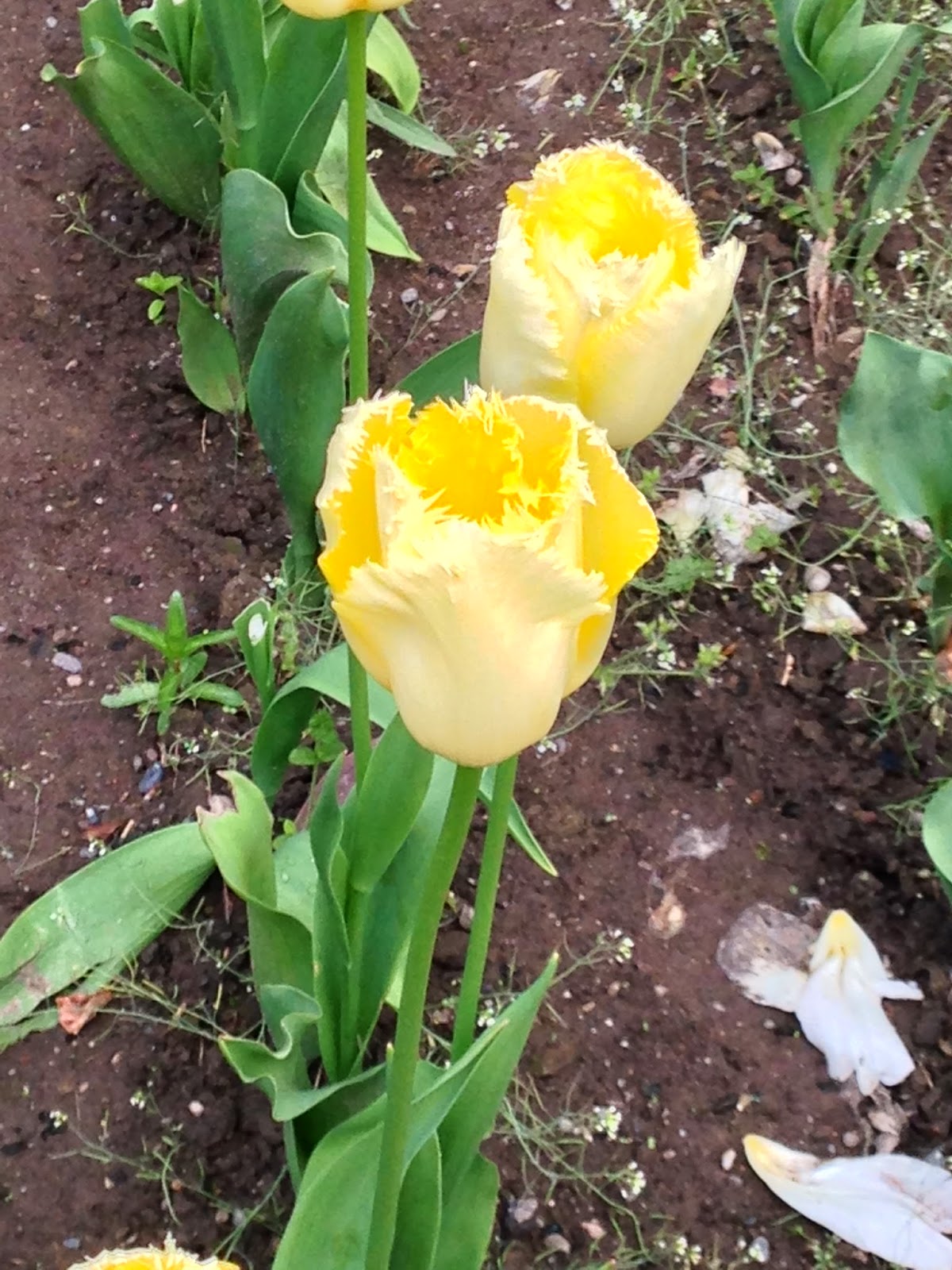


The spring flowers around the castle were still in bloom.  In about a month the grounds will be filled with summer flowers and so beautiful

 
The garden around the Castle


Monday, May 12, 2014

Hail Caledonia!!

We have enjoyed the beauty of Scotland the last few months.  What a wonderful country this is!!


As spring comes into full bloom we have enjoyed the beauty of Scotland.  The weather is getting a wee bit warmer and the days are getting longer again.  This truly is a beautiful country.


The last few weeks have been busy and things will continue to be busy through the end of May.  (We are really not on a vacation but do manage to see a bit of the country as we travel around)   We taught a Career Workshop in Alloa and then one in Falkirk.  Last Saturday we taught another Career workshop in Edinburgh.  We were expecting about 8-10 people so we made sure the room was set to accommodate everyone but only had 4 people show up.


We have been traveling to Glasgow each Tuesday to meet with people there and will likely set up a regular visit in Glasgow for each Tuesday afternoon/evening.  We taught our CV Writing class a couple of weeks ago in Glasgow and have been meeting with a number of young adults to help them find work.  We prepared a PowerPoint presentation for the writing class and our “boss” liked it and it is now being used by all the Stake Employment Specialists in Scotland and Ireland and many Stakes in England.

Thursday of this week we are traveling to the Isle of Lewis to conduct a Career Workshop in Stronoway.  This should be a very interesting, and beautiful trip.  We will visit the Isle of Skye, catch the ferry to the Isle of Harris, then drive to the Isle of Lewis, both of which are part of the Outer Hebrides.  It sounds like another vacation, but we really will be working...at least on Saturday.  ;-)


Saturday, May 3, 2014

A Wee Bus Ride to the Rosslyn Chapel...


This week we took a wee “bus adventure” this week.  We had to take our car in for the annual service so we would either be walking for the day, have someone take us places, or ride the bus.  The bus system in Edinburgh is truly amazing.  One can go most anywhere in the city on a bus and the longest wait during the day is only about 12 minutes.  At night it could be a 20-30 wait.  Most buses in the city are the double-decker kind and riding upstairs gives one a great view of things.  We decided on a wee bus adventure for the day so we dropped off the car for service and then caught the bus to downtown.  Once there, we caught another bus to go see the Rosslyn Chapel.  This was a bus ride out to a small village outside of Edinburgh – Roslin.

 
This is Princes Street in Downtown Edinburgh.  This section of town is restricted to buses, taxi, and the tram...no cars.  During the busy time of day I have seen as many as 10-12 buses along this section of town.

The Rosslyn Chapel has been owned by the Rosslyn family since 1446.  Sir William St. Clair started the chapel but died in 1484 before it was finished.  It took 40 years to finish.  William wanted to show his thankfulness to God so he decided to build the chapel and he wanted it to be built “…with greater glory and splendor…”  The Rosslyn family were devout Catholics and the chapel was to be in the shape of the crucifix with a tower in the center.  When William died, much of the chapel had not been finished.  The foundation had been outlined for the full size but his son Oliver didn’t see the need to spend the family fortune on the church so he finished the main room (it is marvelous workmanship) but did not finish the chapel according to his father’s plans.  He cut off the main extension of the building, thereby eliminating the shape of the cross.

 
Here is a picture from the air showing the chapel.  The wings were part of the original structure and one can see the small extension that was added later by the son Oliver.  The original plan would have extended down towards the trees.

Later in the 18th century an organ loft and baptistery were added.  It is obvious what section was added as the stone is much newer  J  It is only 300 years old instead of 700 years old. 


Exterior of Chapel


After we left the Chapel we walked down to the Rosslyn Castle ruins.  Not much remaining other than the bridge over a deep ravine.
 
Because this is a "working church" we were unable to take pictures on the inside so I have taken many of these from a book we purchased at the visitor center

One interesting story about the interior of the chapel deals with two beautiful columns and the carving detail by stone masons.

There was a master stone carver who carved this column.
 
Column carved by the Master Stone Mason


The legend is that the master stone carver finished the first column.  Sir William liked it but he was interested in having it more like the designs he had seen in Rome.  The master carver went to Rome to see the carvings first hand.  While he was gone (apparently quite a long time) his apprentice had a dream that he had carved the second column.  St William took this as a sign from God and set the apprentice to work.  He finished the column before the master returned.  Upon his return, he was very upset and envious that the second column had been finished and was more beautiful than his column.  Asking who had carved the column, he was told his apprentice had carved it.  The master flew into a rage and hit the apprentice on the head with his mallet which killed him instantly.  The Master Carver was punished for his deed by being hung.
 
 
This is the column carved by the Apprentice.
 
The interior of the chapel is truly a magnificent piece of art.  The chapel  was originally a Catholic Chapel and there was considerable fighting over this during the Reformation.  John Knox was involved in the fighting.  At some point the family let the Chapel go into disrepair and it sat vacant for 270 years...(so one can see how old this building really is).  In the early 1900s, Queen Victoria visited Scotland and went to the Chapel.  She felt that it was a treasure that should be preserved for historical purposes.  Once the Queen took notice of the Chapel, the family decided they should do something to restore it to its original beauty.
 
This is a picture of the ceiling.
 
This is still a working chapel today...however, now it is used by the Church of Scotland.
 
The walk down to the Castle.
 
Remaining wall of the Castle


Monday, April 21, 2014

Vacation…or work? (Maybe a wee bit of both)

There is a hymn in our hymn book that says, “The time is far spent, there is little remaining…”  I feel that way a wee bit this morning.  We are at our one year mark on our mission and there are only six months are remaining until we return home.  We are excited to return home, but “there is little [time] remaining” to do all we want to do.  We received an email this week from one of our granddaughters indicating how much she missed us and said, “it sounds like you are having a good time vacationing and teaching the gospel!”  I guess as one reads our blog it does sound like we are “having a good time vacationing”, but we also are doing some work here.  J


The spring flowers have been amazing.  The daffodils are still blooming and are everywhere.  They come up in the middle of the yards in the grass and are along the roadside.


It is true I have been mostly posting information about our travels, but not much about our work…so one may think that we are on a grand vacation.  As we have traveled in our assignment, we have been able to see many parts of Scotland and Ireland, but we do also work.  Part of the reason I dinna post much about our work is because much of what we do is confidential in nature when we are dealing with individuals who are out of work and are a wee bit discouraged.  I have a separate journal file with a list of names of individuals who “have a story” to tell.  These stories are about their families, problems in finding work, their conversion to the gospel, and so forth.  Many of these stories are very special and posting them on the blog doesn’t seem appropriate.
 
Saturday we drove to Dunfermline and Kinross to see where the Irvine relatives came from.  This is the old train bridge across the Firth of Forth.  Dunfermline is just across the Firth about 5 miles.
 
We drove around the Dunfermline Cemetery.  This was the largest cemetery we have visited here.  The picture is hard to really appreciate how large the area really encompasses.  All the headstones, even the current ones are large standing stones.  It is quite the place to visit but would take hours...no, days...to find someone without a map.  That will be our next challenge.


I thought I would share some things about two individuals we have worked with this week…so you can get an idea of what keeps us going.  (I like to focus on the positive)  Last fall a young adult in the Edinburgh Ward introduced us to a co-worker who needed help with his application to the University.  This fellow is not a member of the Church and is here from Slovakia. He has been living and working in Scotland for about 4 years and was applying to attend University because he now qualifies for government assistance since he is from a European Union country.  He needed help with the grammar for his essay as part of the application process.  We helped him by correcting the grammar in the essay.  He now has conditional acceptance to Harriot Watt University…conditional on passing the international English exam.  The exam has four parts – speaking, listening, reading, and writing.  This week we helped correct his practice writing test.  He is a wonderful young man and we have established a good friendship.  I am sure he will do well on the English exam.
 
 
We were on a walk near our flat and found this Dove Cot structure.  Which was built in the 1500s.

We met with another young man who is age 22 and looking for work for a year until he can return to the university.  He has had one year of College studying IT and 1 ½ years at University working on a degree in forensic IT security.  He isn’t the typical Scot as he has worked continually since he was a 16 year old and while attending school.  He started as a part-time checker in a grocery store and soon was promoted to a full time team leader of the checkers.  He then got a job as security in a bar and is now the supervisor of security.  He wants to go back to the University to finish his IT studies.  We are helping him with his CV (resume) and practicing interviewing skills.


Wednesday evening we going to Glasgow to teach our CV Writing class to a group of young adults.  On Saturday we are teaching our Career workshop in Falkirk and again the following Saturday in Edinburgh.  So, one can see that we actually do some work…in between our travels.   JJJ  In our first year here we have a list of about 85 individuals with whom we have worked to find employment, or get into school.  It can be a rewarding assignment when the “light comes on” and the individuals we are helping realize that they do have some skills and achievements, and can find work!!
 
 
All set up for a workshop...

 
Welcome to our Employment Centre...please sign in!!

 Cheers…until next time.

Monday, April 14, 2014

Easter Concert...


This has been a slow week again for employment efforts but a special week none the less.  My last post told about our wee trip to the town of Oban.  It was grand to see the beauty of this land.  Last Sunday was our General Conference for the Church.  Every six months a General Conference is held in Salt Lake City where members gather to hear counsel and instruction from our Church leaders.  The meeting is held in the Conference Center in Salt Lake City and is broadcast via radio, television, satellite, and the internet throughout the world to allow millions to watch the proceedings.  Much of the music for the conference is provided by the Mormon Tabernacle Choir.


The April Conference of the Church is always special because it is held near Easter.  This year the Sunday sessions were held on April 6th – the day the Church was organized in 1830.  The recordings of the Conference are available to anyone on lds.org.  It is a chance to listen to a Prophet’s counsel and teachings on how we should live our life.  We sustain the First Presidency  and the Quorum of the Twelve Apostles as prophets, seers, and revelators.


This week has also been special because we were asked to help with the Mission Choir.  The Scotland/Ireland Mission created an ad-hoc choir at Christmas time by selecting some of the young missionaries living in Scotland and they performed in a number of locations.  It was so successful that they have put together another Choir for a series of Easter concerts which were held in Glasgow, Dundee, and Edinburgh.  The concert was called “He Lives” and included many songs about Jesus Christ and his resurrection. 


The first concert was held in Glasgow Thursday night.  We caught the bus in Edinburgh on Friday morning and met the Choir at St. Paul’s Cathedral in the center of Dundee.  The second concert was to be held in that cathedral.  This was a special experience to have the Choir sing in one of these magnificent buildings.  The acoustics are amazing.


St. Paul’s Cathedral was built in 1853…not that old as cathedrals go.  J  It was a very impressing building.  I was able to go up to the bell tower and take some pictures looking down to the main part of the building.


There were 32 young missionaries who performed in the Choir and they are truly talented.  Some accompanied the Choir with violins, a cello, the piano, organ, flutes, trumpets, and of course…a bag pipe.  One of the missionaries from Ohio has been playing the bag pipe for about 5 years and he accompanied the Choir as they sang Amazing Grace.  They love the work they are doing to share the gospel message of Jesus Christ.


There were only about 30 people in attendance but the Choir sounded great.  Because of their missionary responsibilities they only had 3 days practice before the first concert.  They put on the next concert Friday evening at the Dundee Stake Building and there were about 180 people in attendance.  We assisted in making sure the details of transport, meals, and lodgings were handled.
 

Friday morning the bus took us to Edinburgh for a concert in St. Giles’ Cathedral.  This was an amazing performance.


St Giles' Cathedral, more properly termed the High Kirk of Edinburgh, is the principal place of worship of the Church of Scotland in Edinburgh. Its distinctive crown steeple is a prominent feature of the city skyline, at about a third of the way down the Royal Mile which runs from the Castle to Holyrood Palace. The church has been one of Edinburgh's religious focal points for approximately 900 years. The present church dates from the late 14th century, though it was extensively restored in the 19th century.  Today it is sometimes regarded as the "Mother Church of Presbyterianism". The cathedral is dedicated to Saint Giles, who is the patron saint of Edinburgh, as well as of cripples and lepers, and was a very popular saint in the Middle Ages.


St Giles' was only a cathedral in its formal sense (i.e. the seat of a bishop) for two periods during the 17th century (1635–1638 and 1661–1689). In the mediaeval period, prior to the Reformation, Edinburgh had no cathedral as the royal burgh was part of the Diocese of St Andrews, under the Bishop of St Andrews whose episcopal seat was St Andrew's Cathedral. For most of its post-Reformation history the Church of Scotland has not had bishops, dioceses, or cathedrals. As such, the use of the term cathedral today carries no practical meaning. The "High Kirk" title is older, being attested well before the building's brief period as a cathedral.


The choir performance was wonderful.  There were nearly 200 people in the Cathedral during the performance and many offered very positive comments about the quality of the performance.  The message of the music was that Jesus Christ has atoned for our sins and that he gave his life for us that we might return to live with a loving Heavenly Father.  The ending numbers for each concert were "I know that my redeemer lives", "This is the Christ", and the "Hallelujah Chorus" from The Messiah.  The last concert was performed in the Edinburgh Stake Building with about 150 in attendance.  It was a wonderful experience to be with the Choir and feel the spirit as they sang.
Our message to the world is that Jesus Christ is the Son of God and our Savior and Redeemer and that He lives and is guiding His Church today through his  Apostles and Prophets.

Tuesday, April 8, 2014

A wee trip to Oban and Inveraray...


Last weekend we took some time off and took a wee trip Friday afternoon and Saturday and drove to the west coast of Scotland to a town called Oban.  We drove from Edinburgh to Stirling and then through Callandar and across to Oban on the A85.  The drive was beautiful but would have even been better in a few weeks as the trees begin to show more green leaves.  Most of the castles are opening back up for the tourist season so we will see many more as we travel throughout Scotland.


On the road to Oban on the A85

The town of Oban is only about 200 years old, but there are castle ruins nearby that date back to the 13th century.   
 
 
Oban Bay looking out from main street.
 

On the hill behind the town, overlooking the bay there is a structure that looks like a coliseum.  The story is told that a wealthy man in the city was worried about the mason workers who were out of work in the winter.  So he hired them to build him a home on the hill to keep them working.  The structure was never finished as he died before it was finished.  The view from the top is very nice


The daffodils are in bloom everywhere.  They are along the side of the road, in pastures, lawns, just about everywhere.


Overlooking the bay from the top of the hill.

 
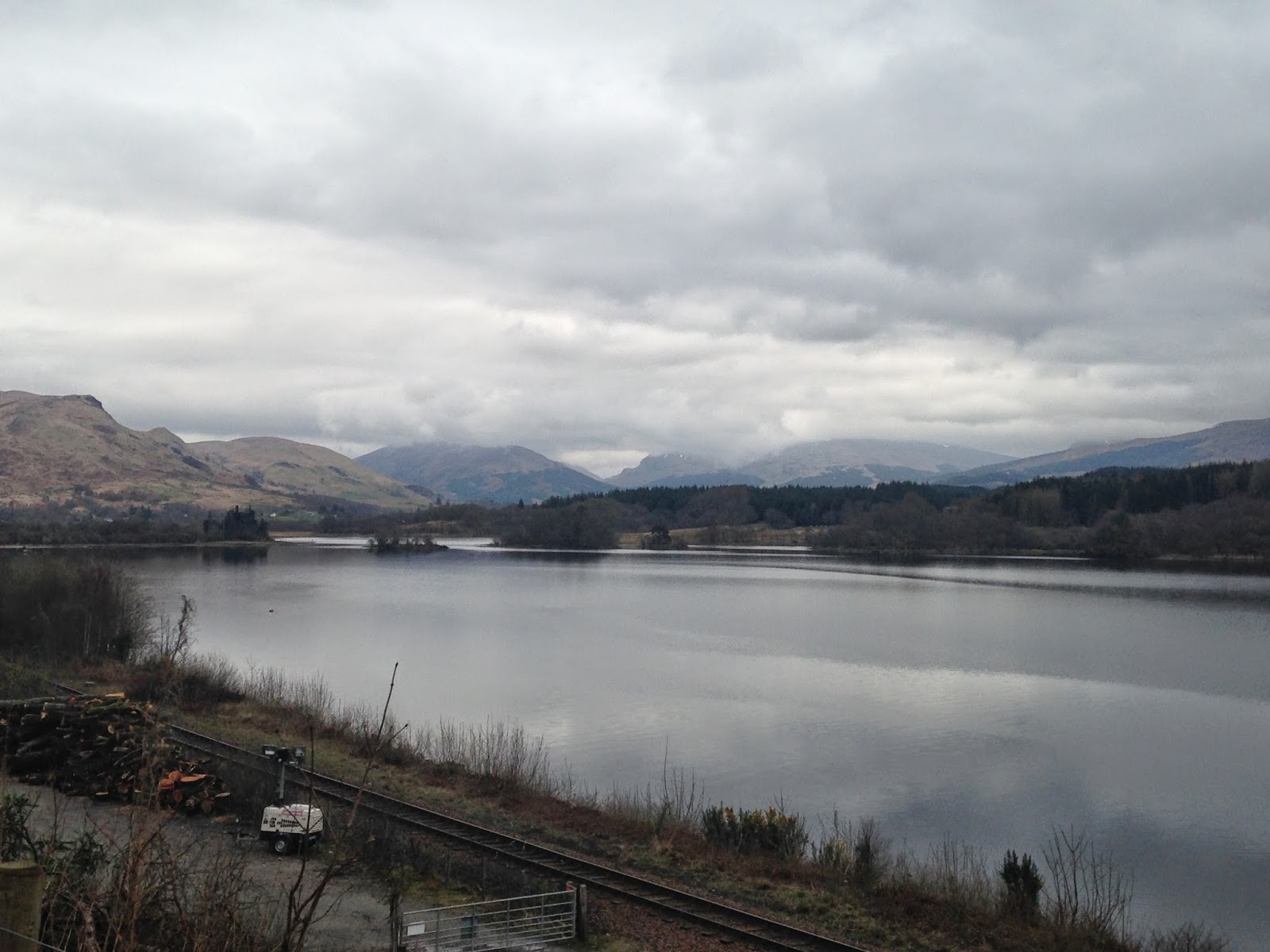
We stayed overnight in Oban and then drove to Inveraray on Saturday.  On the way we passed the Kilchurn Castle (pronounced – “ki-learn” with a sound from the back of the throat) located at the north end of Loch Awe.  This castle is a ruin with not much to see other than from the outside.  
 
Kilchurn Castle
 
Kilchurn Castle was built in the mid-1400s by Sir Colin Campbell, 1st Lord of Glenorchy.  In the 14th to 15th century, the various Campbell clans controlled most of the southwestern part of Scotland.

In 1432, Colin, second son of Duncan Campbell (later 1st Lord Campbell), was granted Glenorchy, at the north end of Loch Awe.  Kilchurn remained the powerbase for the Campbells for 150 years. It was not abandoned until the 1700s.
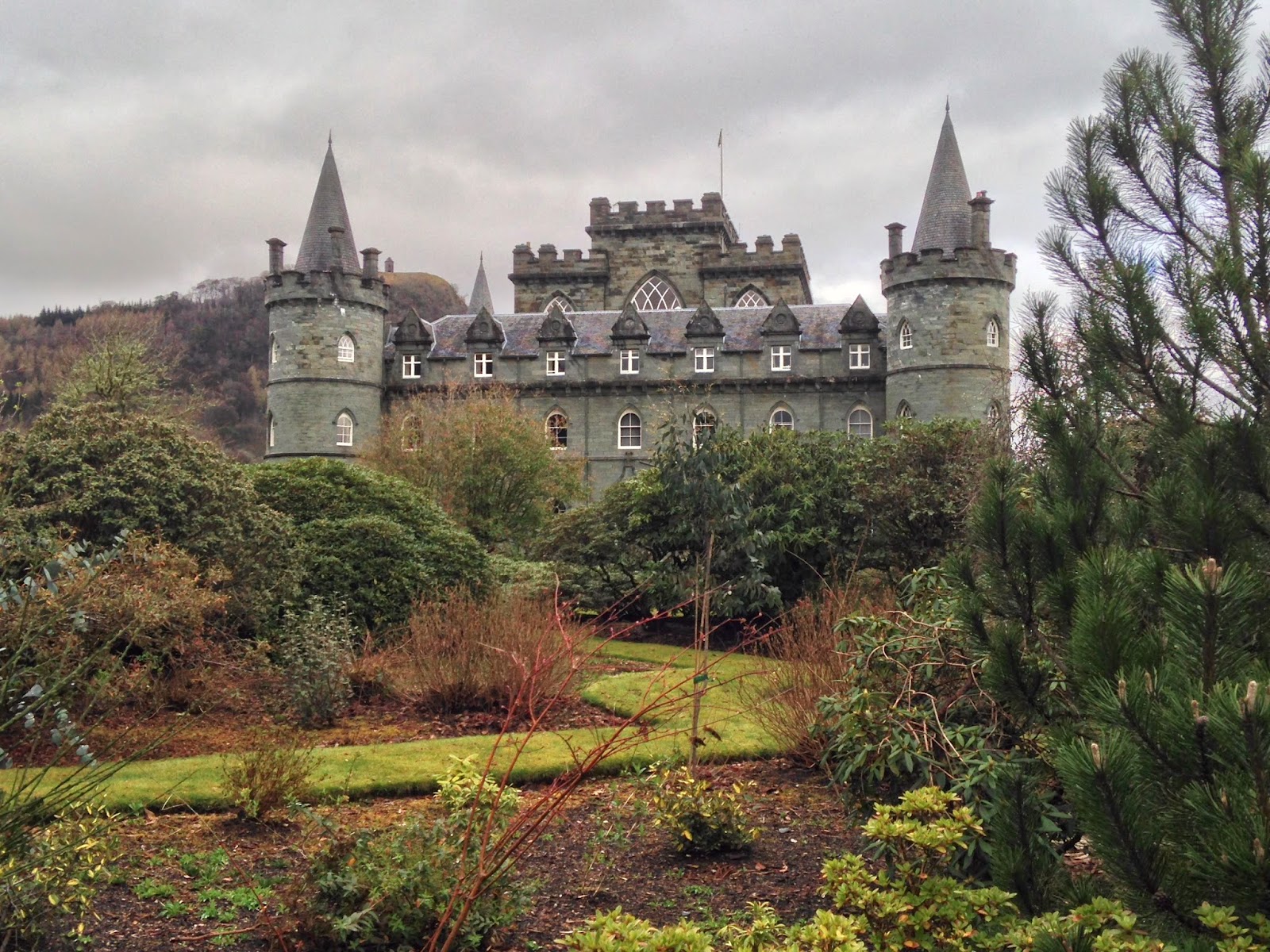
We next stopped in Inveraray to see the castle.  Inveraray Castle is the ancestral home of the Duke of Argyll, Chief of the Clan Campbell.  Inveraray Castle is first and foremost a family home rather than a castle built for defense.    The Campbells fought with King Robert the Bruce at the Battle of Bannock Burn in 1314 when they defeated the English (Edward II)  in the Wars of Scottish Independence.


For all you Downton Abbey fans, this is the location used to film the summer vacation at the end of the 3rd season.  This is the group of missionaries that traveled with us for the weekend.

 
The tour of the castle was on the first two floors on the left side of the castle.  We went into about a dozen rooms out of the nearly 100 that are in the castle.  The family lives in the castle and uses all of the rooms at certain times of the year.


Fields of daffodils.


The 13th Earl (Duke of Argyll) and his family currently live in the castle when they visit Scotland.   

From Inveraray we returned home by driving down the west coast of Loch Lomond and through Glasgow to Edinburgh